
- PV-Station-Solutions
- PV-Panel-Testing-Solutions
- Silicon-Ingot-Testing-Solutions
PID, short for **Potential Induced Degradation**, refers to a phenomenon where the performance of solar cells deteriorates continuously due to ion migration triggered by the potential difference between internal materials of PV modules under long-term high-voltage bias. First systematically proposed by SunPower in 2005, it is a core issue affecting the long-term reliability of PV modules.
| Type | Abbreviation | Core Characteristics | Impact Level | Reversibility |
|---|---|---|---|---|
| Power Attenuation Type | PID-P | The most common type; sodium ion migration damages anti-reflection coatings and pn junctions, reducing parallel resistance | Severe (power loss up to 30%) | Partially reversible |
| Short-Circuit Current Attenuation Type | PID-S | Degradation of the passivation layer on the cell surface, increasing carrier recombination | Moderate | Reversible |
| Open-Circuit Voltage Attenuation Type | PID-V | Mainly affects n-type cells, reducing minority carrier lifetime | Mild | Reversible |

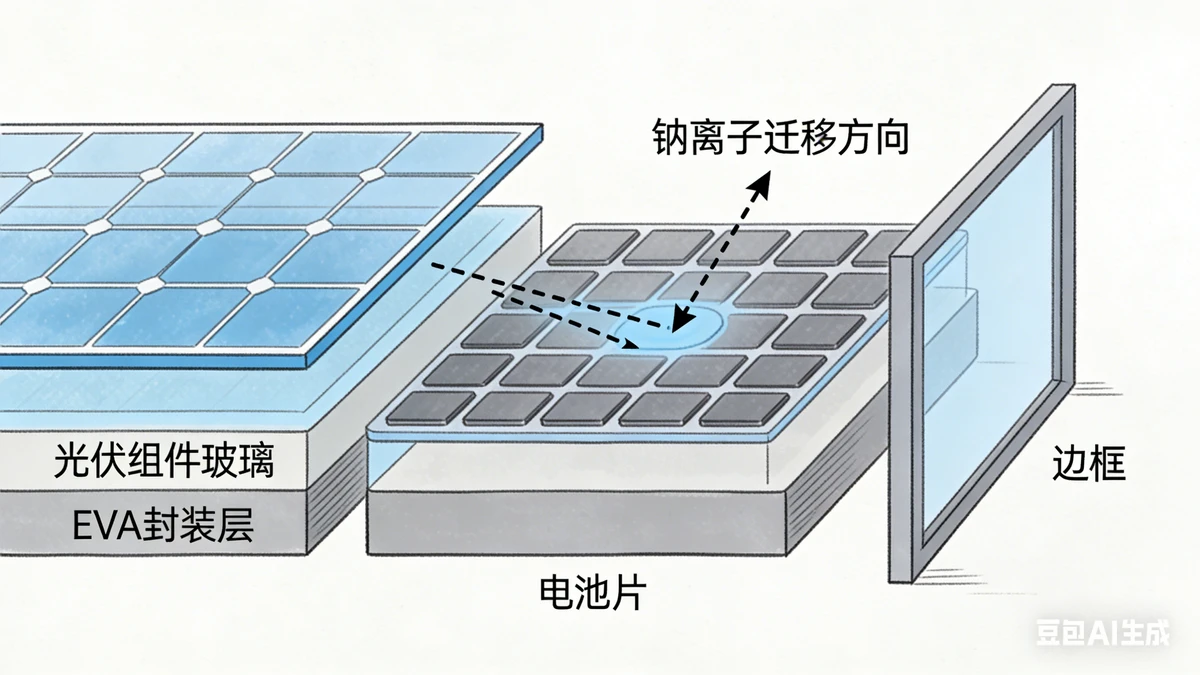
The essence of the PID effect is **electric field-driven ion migration and leakage current formation**, with the complete process as follows:
Establishment of Potential Difference:After the module frame is grounded, a high voltage difference (usually 1000-1500V systems) is formed between solar cells and the frame.
Formation of Conductive Channels:- Moisture absorption by encapsulation materials (e.g., EVA) in high-humidity environments (or condensation) forms a conductive medium required for ion migration.
Ion Migration:Under negative bias, mobile ions such as **sodium ions (Na⁺)** in glass and encapsulation materials migrate toward the cell surface.
Performance Degradation:Sodium ions accumulate on the surface of the cell's anti-reflection layer (SiNₓ), damaging the passivation effect and resulting in:
Decreased parallel resistance and increased leakage current
Reduction in fill factor (FF), open-circuit voltage (Voc), and short-circuit current (Isc)
Ultimately, significant attenuation of the module's maximum power (Pmax)
Voltage Conditions(Necessary Condition):The higher the negative bias voltage of the module relative to the ground, the more significant the PID effect; generally, the more modules in series (higher system voltage), the greater the risk.
**Environmental Conditions(Accelerating Condition):
Humidity: Ion migration rate increases sharply when relative humidity exceeds 60%
Temperature: The PID rate approximately doubles for every 10°C increase; attenuation is fastest at 85°C
Module-Specific Factors:
Encapsulation Materials: Early EVA is prone to moisture absorption with poor PID resistance; POE materials perform better
Glass Type: Ordinary soda-lime glass contains a large amount of sodium ions; low-sodium glass can reduce risks
Cell Type: p-type cells are more sensitive to PID, while n-type cells (e.g., TOPCon, HJT) have stronger PID resistance
Encapsulation Process: Lamination quality and edge sealing directly affect moisture intrusion
Power Generation Loss**: 10%-30% module power attenuation directly impacts the power plant's IRR (Internal Rate of Return)
Service Life Reduction: Long-term PID effect may cause irreversible damage such as hot spots and microcracks in modules
Increased Operation and Maintenance Costs: Additional resources need to be invested in testing, repair, and even module replacement
Safety Risks: Increased leakage current may cause local overheating of modules, posing fire hazards
IEC TS 62804-1 标准: Specifies three testing methods to evaluate the PID resistance of modules
Dark-State Testing: Apply negative bias voltage (typically -1000V) to modules and maintain them in an 85℃/85%RH environment for 96 hours
Light-State Testing: Simulate actual operating conditions to evaluate PID effect under illumination
Power Attenuation Criterion: A Pmax attenuation rate ≤ 5% before and after testing is considered qualified, and ≤ 2% is excellent
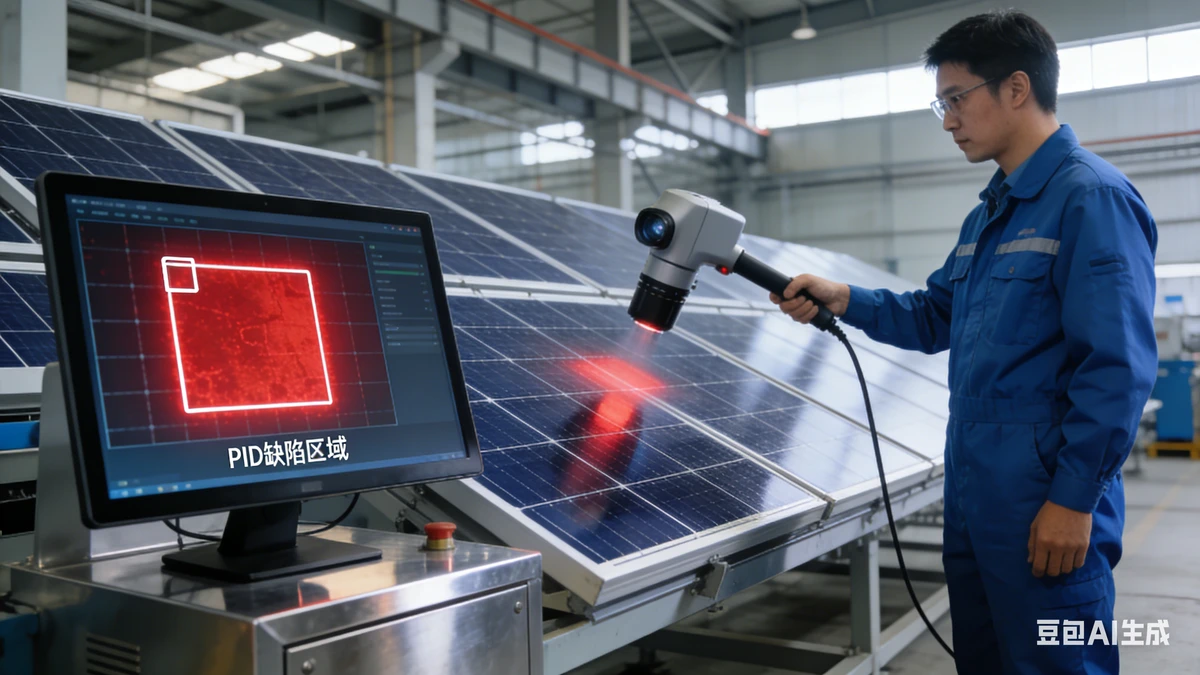
EL (Electroluminescence) Testing: EL images of PID-affected modules showblack spots/streaks,corresponding to leakage current areas
IV Curve Testing: Compare the actual Pmax of modules with the nominal value to calculate the attenuation rate
Leakage Current Monitoring: Install leakage current sensors to real-time monitor the leakage current of modules to the ground (normal value < 10μA)
Thermal Imaging Testing: Severe PID areas generate local overheating due to leakage current, which can be detected as abnormal hot spots via thermal imaging
Adoptlow-sodium glassOptimize cell passivation processes to enhance surface resistance to ion contaminationPID-resistant encapsulation materials(e.g., POE/EVA blend films)
Optimize cell passivation processes to enhance surface resistance to ion contamination
Addmoisture-proof sealing layers at module edges to reduce moisture intrusion
Conduct PID preconditioning(e.g., positive bias aging) before factory shipment to activate PID resistance performance
| Technical Solution | Working Principle | Applicable Scenarios |
|---|---|---|
| Positive Grounding of Modules | Eliminates negative bias voltage of solar cells, fundamentally preventing ion migration | Newly built power plants, suitable for p-type modules |
| PID Restorers | Apply reverse voltage (+1000V) at night to move migrated ions back | Existing power plants with reversible PID |
| System Voltage Optimization | Reduce the number of series-connected modules to lower system voltage (e.g., from 1500V to 1000V) | Power plants in high-humidity areas |
| Frame Insulation Treatment | Add insulation layers between frames and module interiors to reduce leakage current | Distributed power plants with space constraints |
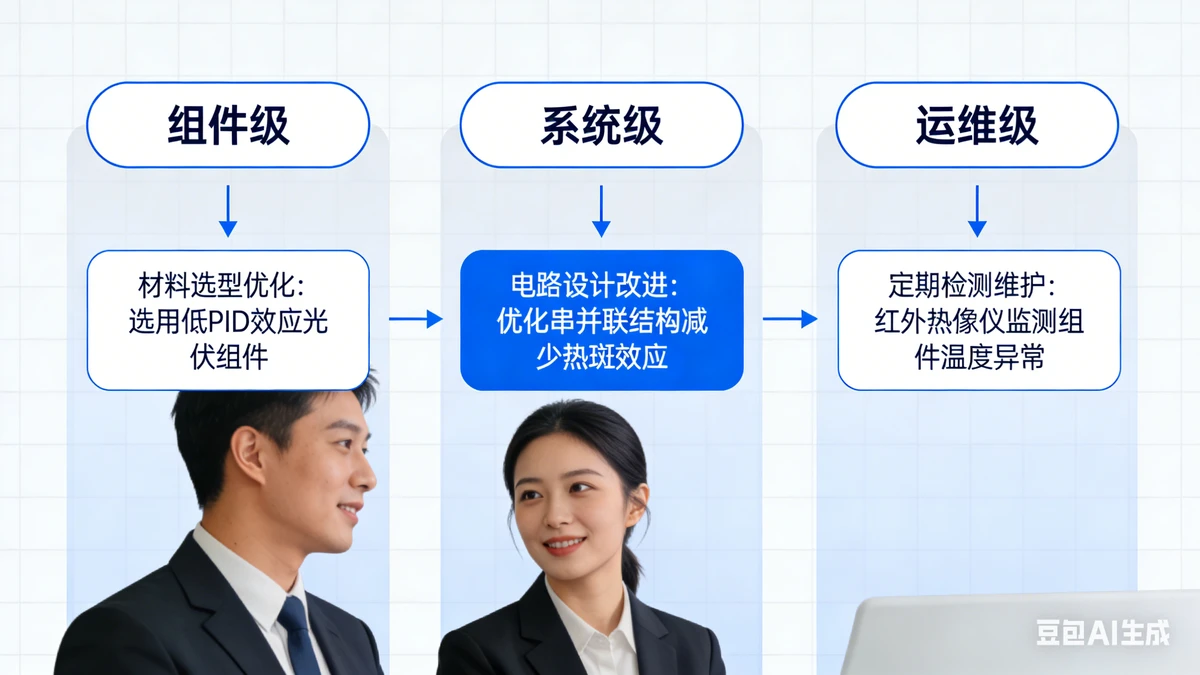
Regular Testing**: Conduct combined EL + IV + thermal imaging testing every 6-12 months to identify early-stage PID modules
Environmental Monitoring: Deploy temperature and humidity sensors in power plants and strengthen inspections during high-risk periods (plum rain season, summer)
Timely Repair: Use restorers to treat lightly affected PID modules and replace severely attenuated modules promptly
Cleaning and Maintenance: Regularly clean module surfaces to reduce local potential differences caused by dust accumulation
As a manufacturer of photovoltaic inspection equipment, Shichuang Intelligence can provide the following PID-specific inspection solutions:
AI-EL Automatic Detection System**: Automatically identify PID features (black spots/streaks) with high-resolution EL imaging and deep learning algorithms, achieving a detection accuracy of over 99%
Online PID Monitoring Equipment: Integrate leakage current sensors and thermal imaging modules to real-time monitor module PID status and provide early warnings
PID Repair Effect Verification System: Compare EL images and IV curves before and after repair to quantify repair effectiveness (power recovery rate)
Technological Evolution: Thanks to structural advantages, n-type cells (TOPCon, HJT) have significantly better PID resistance than p-type cells and have become the mainstream in the future
Standard Upgrade: IEC 62804-1:2025 adds light-state testing methods, which are more in line with actual operating conditions
Cost Optimization: The cost of PID-resistant materials decreases year by year and has become a standard configuration for modules (market share > 90% in 2025)
contact
Be the first to know about our new product launches, latest blog posts and more. Nanjing Vision Potential Intelligent Technology Co.,Ltd.Established based on the Nanjing Xiangning Artificial Intelligence Research Institute, we have brought together a number of outstanding industry... Any question or request?
Click below, we’ll be happy to assist. contact